
The bertha armyworm, spotted cutworm, and cabbage looper are the most important caterpillars of Lepidopteran moths found in potatoes in the Pacific Northwest. They are pests because they feed on potato leaves. Infestations usually start in early summer.
Scouting: Loopers may be found feeding on the leaves during the day. Other species are nocturnal and are more difficult to scout, but they may be found by lifting up the plants and looking at the soil surface. Caterpillars get larger as they progress through several larval instars; growing up to 1.5 to 2 inches long.
Damage: Studies have shown that potato plants can tolerate at least 10% defoliation by these caterpillars with no marketable yield loss. They are slower to buildup populations compared to Colorado potato beetles, and are much slower to defoliate plants. Early infestations are more important (more destructive) than late infestations.
Photos
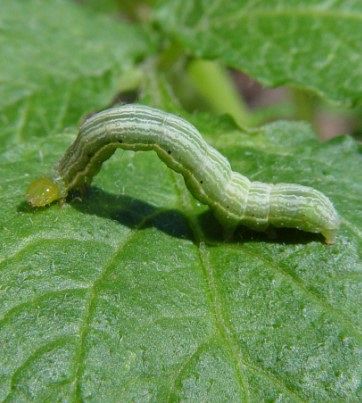
A cabbage looper (photo by Andy Jensen, NW Potato Research Consortium).
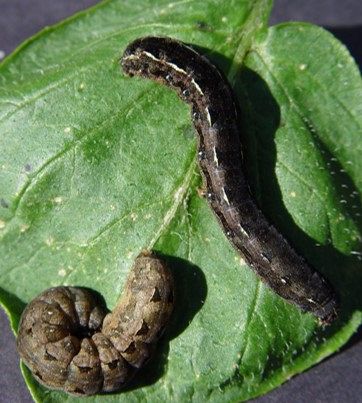
Western yellow striped armyworms (photo by Andy Jensen, NW Potato Research Consortium).
Control Options for Armyworms, Cutworms, Loopers on Potatoes
| Material | Application per Acre | REI (hours) |
PHI (days) |
MOA | Efficacy | Notes |
|---|---|---|---|---|---|---|
|
esfenvalerate (Asana XL) |
5.8-9.6 fl oz | 12 h | 7 d | 3 | G | Apply when small caterpillars are present, but only if it’s before mid-June. |
|
indoxacarb (Avaunt Insecticide) |
2.5-6 oz | 12 h | 7 d | 22 | E-G | Apply when caterpillars are small. |
|
azadirachtin (Aza-Direct) |
1-3.5 pt | 4 h | 0 d | NC | ND | Apply when caterpillars are small. If needed, follow-up with 2-3 applications at 7-10 day intervals. |
|
beta-cyfluthrin (Baythroid XL) |
1.6 to 2.8 fl oz | 12 h | 0 d | 3 | G | Apply when small caterpillars are present, but only if it’s before mid-June. |
|
spinosad (Blackhawk) |
2.25-3.5 oz | 4 h | 7 d | 5 | G | Apply when larvae are small. The lower rate of 2.25 oz. per acre may be used for small larvae, and 3 to 3.5 oz. per acre should be used for larger larvae, but the largest larval stages may not be controlled at any rate. |
|
bifenthrin (Brigade 2EC) |
2.1-6.4 fl oz | 12 h | 21 d | 3 | G | Worms are on the label but not in the potato section. Apply when small caterpillars are present, but only if it’s before mid-June. |
|
bifenthrin + imidacloprid (Brigadier) |
4.8-6.14 fl oz | 12 h | 21 d | 3, 4A | G | Apply when caterpillars are small, but only if it’s before mid-June. |
|
novaluron + acetamidiprid (Cormoran) |
6-12 fl oz | 12 h | 14 d | 15, 4A | E | Apply when caterpillars are small. |
|
spinetoram (Delegate WG) |
3-4 oz | 4 h | 7 d | 5 | E | Apply when caterpillars are small. |
|
cyantraniliprole (Exirel) |
See Label | 12 h | 7 d | 28 | E | Apply when caterpillars are small. |
|
methomyl (Lannate LV) |
1.5-3.0 pt | 48 h | 6 d | 1A | G | Kills worms on contact for knockback control, but it may also knockback some beneficial, predatory insects. Apply when insects are active. |
|
beta-cyfluthrin + imidacloprid (Leverage 360) |
2.8 fl oz | 12 h | 7 d | 3, 4 | G | Apply when caterpillars are small, but only if it’s before mid-June. |
|
abamectin + cyantraniprole (Minecto Pro) |
See Label | 12 h | 14 d | 6, 28 | E | Apply when caterpillars are small. |
|
zeta-cypermethrin (Mustang Maxx) |
See Label | 12 h | 1 d | 3 | G | Apply when small caterpillars are present, but only if it’s before mid-June. |
|
azadirachtin (Neemix 4.5 IGR) |
4-10 fl oz | 4 h | 0 d | NC | ND | Apply when caterpillars are small. If needed, follow-up with 2-3 applications at 7-10 day intervals. |
|
pyrethrins (PyGanic Crop Protection EC 5.0) |
4.5-15.61 fl oz | 12 h | 0 d | 3A | ND | Apply when caterpillars first appear. Don’t wait until plants are heavily infested. |
|
spinetoram (Radiant SC) |
6-8 fl oz | 4 h | 7 d | 5 | E | Apply when caterpillars are small. |
|
novaluron (Rimon) |
6-12 fl oz | 12 h | 14 d | 15 | E | Apply when larvae are small. |
|
tolfenpyrad (Torac) |
See Label | 12 h | 14 d | 21A | G | Lepidopteran caterpillars are on the label but not in the potato section. It can knockback their numbers, especially if used when caterpillars are small. |
|
chlorantraniliprole (Vantacor) |
1.2-2.5 fl oz | 4 h | 14 d | 28 | E | Apply when larvae are small. |
|
lambda-cyhalothrin (Warrior II) |
fl oz | 24 h | 7 d | 3 | G | Apply when small caterpillars are present, but only if it’s before mid-June. |
More details
More details
More details
More details
More details
More details
More details
More details
More details
More details
More details
More details
More details
More details
More details
More details
More details
More details
More details
More details
More details
| Material | Application per Acre | REI (hours) |
PHI (days) |
MOA | Efficacy | Notes |
|---|---|---|---|---|---|---|
|
esfenvalerate (Asana XL) |
5.8 to 9.6 fl oz | 12 h | 7 d | 3 | P | Use of pyrethroid insecticides is not recommended mid-season. If used, apply when small caterpillars are present. Monitor for subsequent pest outbreaks. |
|
indoxacarb (Avaunt Insecticide) |
2.5-6 oz | 12 h | 7 d | 22 | E-G | Apply when caterpillars are small. |
|
azadirachtin (Aza-Direct) |
1-3.5 pt | 4 h | 0 d | NC | ND | Apply when caterpillars are small. If needed, follow-up with 2-3 applications at 7-10 day intervals. |
|
beta-cyfluthrin (Baythroid XL) |
1.6 to 2.8 fl oz | 12 h | 0 d | 3 | P | Pyrethroid insecticides should not be applied mid-season. If used, apply when small caterpillars are present. Monitor for subsequent pest outbreaks. |
|
spinosad (Blackhawk) |
2.25-3.5 oz | 4 h | 7 d | 5 | G | Apply when larvae are small. The lower rate of 2.25 oz. per acre may be used for small larvae, and 3 to 3.5 oz. per acre should be used for larger larvae, but the largest larval stages may not be controlled at any rate. |
|
bifenthrin (Brigade 2EC) |
2.1 to 6.4 fl oz | 12 h | 21 d | 3 | P | Worms are on the label but not in the potato section. Use of pyrethroid insecticides is not recommended mid-season. If used, apply when small caterpillars are present. Monitor for subsequent pest outbreaks. |
|
bifenthrin + imidacloprid (Brigadier) |
4.8-6.14 fl oz | 12 h | 21 d | 3, 4A | P | Use of pyrethroid insecticides is not recommended mid-season. If used, apply when caterpillars are small. Monitor for subsequent pest outbreaks. |
|
novaluron + acetamidiprid (Cormoran) |
6-12 fl oz | 12 h | 14 d | 15, 4A | E | Apply when caterpillars are small. |
|
spinetoram (Delegate WG) |
3-4 oz | 4 h | 7 d | 5 | E | Apply when caterpillars are small. |
|
cyantraniliprole (Exirel) |
See Label | 12 h | 7 d | 28 | E | Apply when caterpillars are small. |
|
methomyl (Lannate LV) |
1.5-3.0 pt | 48 h | 6 d | 1A | G | Kills worms on contact for knockback control, but it may also knockback some beneficial, predatory insects. Apply when insects are active. |
|
beta-cyfluthrin + imidacloprid (Leverage 360) |
2.8 fl oz | 12 h | 7 d | 3, 4 | P | Use of pyrethroid insecticides is not recommended mid-season. If used, apply when caterpillars are small. Monitor for subsequent pest outbreaks. |
|
abamectin + cyantraniprole (Minecto Pro) |
See Label | 12 h | 14 d | 6, 28 | E | Apply when caterpillars are small. |
|
zeta-cypermethrin (Mustang Maxx) |
See Label | 12 h | 1 d | 3 | P | Use of pyrethroid insecticides is not recommended mid-season. If used, apply when small caterpillars are present. Monitor for subsequent pest outbreaks. |
|
azadirachtin (Neemix 4.5 IGR) |
4-10 fl oz | 4 h | 0 d | NC | ND | Apply when caterpillars are small. If needed, follow-up with 2-3 applications at 7-10 day intervals. |
|
pyrethrins (PyGanic Crop Protection EC 5.0) |
4.5-15.61 fl oz | 12 h | 0 d | 3A | ND | Apply when caterpillars first appear. Don’t wait until plants are heavily infested. |
|
spinetoram (Radiant SC) |
6-8 fl oz | 4 h | 7 d | 5 | E | Apply when caterpillars are small. |
|
novaluron (Rimon) |
6-12 fl oz | 12 h | 14 d | 15 | E | Apply when larvae are small. |
|
tolfenpyrad (Torac) |
See Label | 12 h | 14 d | 21A | G | Lepidopteran caterpillars are on the label but not in the potato section. It can knockback their numbers, especially if used when caterpillars are small. |
|
chlorantraniliprole (Vantacor) |
1.2-2.5 fl oz | 4 h | 14 d | 28 | E | Apply when larvae are small. |
|
lambda-cyhalothrin (Warrior II) |
fl oz | 24 h | 7 d | 3 | P | Use of pyrethroid insecticides is not recommended mid-season. If used, apply when small caterpillars are present. Monitor for subsequent pest outbreaks. |