
Damage: The larval stage of the potato tuberworm (the adult stage is a moth) can damage potato tubers in the weeks leading up to harvest, especially after vine kill or vine senescence, when larvae are forced to move from the vines to tubers. The larvae feed on tubers causing tunnels.
Scouting: Potato tuberworms are easy to monitor using pheromone traps. The pheromone lure used inside the sticky trap attracts male moths that are looking for females. Click HERE for a guide to deploying pheromone traps.
Scientific Name:
Phthorimaea operculella
Type:
Insects & Mites
Photos
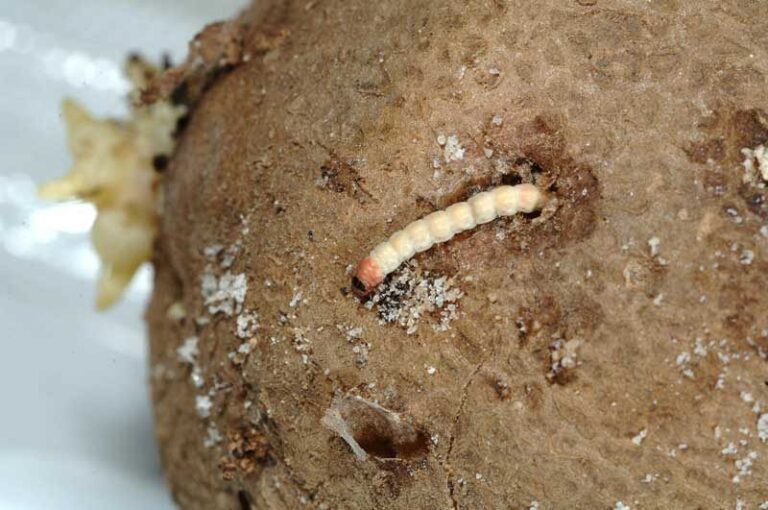
Potato tuberworm larva feeding on a tuber.
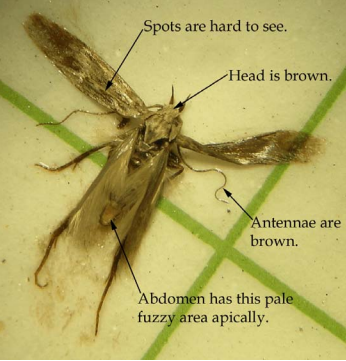
Potato tuberworm moth on a sticky card (photo by Andy Jensen, NW Potato Research Consortium).
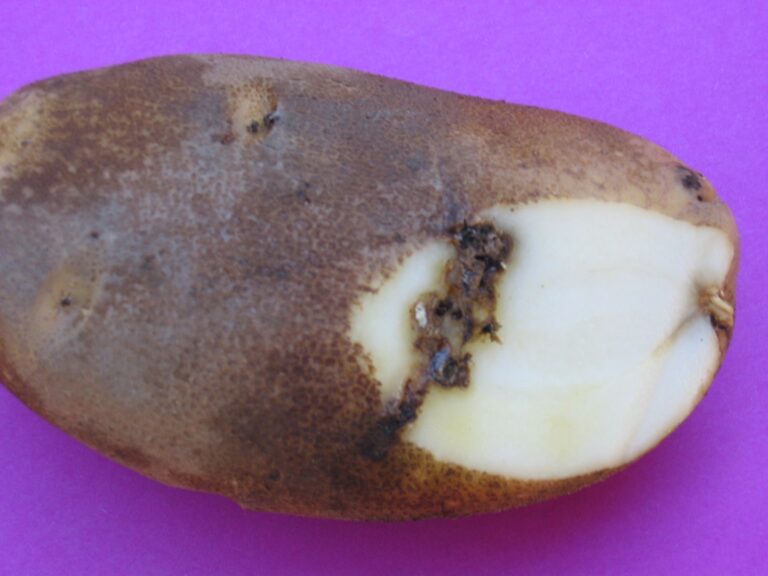
Tuberworm feeding injury (photo by Gary Pelter, retired WSU).
Control Options for Tuberworm on Potatoes
| Material | Application per Acre | REI (hours) |
PHI (days) |
MOA | Efficacy | Notes |
|---|---|---|---|---|---|---|
|
esfenvalerate (Asana XL) |
2.9-9.6 fl oz | 12 h | 7 d | 3 | E | Target PTW larvae feeding in the canopy in the weeks prior to vine desiccation or harvest. PHI is 7-days. Thorough coverage of foliage is essential. Use high water volumes with ground or aerial applications to ensure the product is well distributed in the foliage. |
|
indoxacarb (Avaunt Insecticide) |
3-6 oz | 12 h | 7 d | 22 | G | Target PTW larvae feeding in the canopy in the weeks prior to vine desiccation or harvest. PHI is 7-days. Use a MSO adjuvant to increase translaminar movement. |
|
azadirachtin (Aza-Direct) |
1-3.5 pt | 4 h | 0 d | NC | F | Target PTW larvae feeding in the canopy in the weeks before vine desiccation or harvest. If needed, follow-up with 2-3 applications at 7-10 day intervals. |
|
beta-cyfluthrin (Baythroid XL) |
1.6-2.8 fl oz | 12 h | 0 d | 3 | E | Target PTW larvae feeding in the canopy in the weeks prior to vine desiccation or harvest. Baythroid XL has a 0-day PHI. |
|
bifenthrin (Brigade 2EC) |
2.1 to 6.4 fl oz | 12 h | 21 d | 3 | G-F | Tuberworm is not on the label but applications targeting other pests can control them. Apply in the weeks prior to vine desiccation or harvest when larvae are feeding in the foliage. The PHI is 21-days. Thorough coverage of foliage is essential. Use high water volumes with ground or aerial applications to ensure that the product is well distributed in the foliage. Use at least 0.5 inches of water per acre for chemigation. |
|
bifenthrin + imidacloprid (Brigadier) |
4.8-6.14 fl oz | 12 h | 21 d | 3, 4A | G | Target PTW larvae feeding in the canopy in the weeks prior to vine desiccation or harvest. PHI is 21-days. Minimum re-treatment interval is 7-days. |
|
novaluron + acetamidiprid (Cormoran) |
6-12 fl oz | 12 h | 14 d | 15, 4A | G-F | Target PTW larvae feeding in the canopy in the weeks prior to vine desiccation or harvest. PHI is 14-days. |
|
spinosad (Entrust SC Naturalyte Insect Control) |
See Label | 4 h | 7 d | 5 | G | The label does not mention tuberworm, but it should provide some control. Target PTW larvae feeding in the canopy in the weeks prior to vine desiccation or harvest. PHI is 7-days. A spray adjuvant (OMRI-approved emulsified crop oil or methylated crop oil plus organosilicone) may improve control. |
|
cyantraniliprole (Exirel) |
7-13.5 fl oz | 12 h | 7 d | 28 | E | Target PTW larvae feeding in the canopy in the weeks prior to vine desiccation or harvest. PHI is 7-days. For best results, chemigate in 0.1-to-0.2-acre inches of water and add MSO at 12 to 16 fl. oz per acre. Foliar sprays may not provide adequate control of larvae in the mid to lower canopy. |
|
phosmet (Imidan 70-W) |
1.33 lb | 5 d | 7 d | 1B | F | Target PTW larvae feeding in the canopy in the weeks prior to vine desiccation or harvest for knockback control. PHI is 7-days. Can be re-applied after 10 days. |
|
methomyl (Lannate LV) |
1.5-3.0 pt | 48 h | 6 d | 1A | E | Target PTW larvae feeding in the canopy in the weeks prior to vine desiccation or harvest. PHI is 6-days. Expect only 5-7 days of residual activity. |
|
beta-cyfluthrin + imidacloprid (Leverage 360) |
2.8 fl oz | 12 h | 7 d | 3, 4 | E | Target PTW larvae feeding in the canopy in the weeks prior to vine desiccation or harvest. PHI is 7-days. |
|
abamectin + cyantraniprole (Minecto Pro) |
5.5 to 10 fl oz | 12 h | 14 d | 6, 28 | E | Target PTW larvae feeding in the canopy in the weeks prior to vine desiccation or harvest. PHI is 14-days. Repeat the application after 7+ days if needed to maintain control. |
|
zeta-cypermethrin (Mustang Maxx) |
fl oz | 12 h | 1 d | 3 | E | Tuberworm is not on the label but applications targeting other pests can control them. Target PTW larvae feeding in the canopy in the weeks prior to vine desiccation or harvest. PHI is 1-day. Ground or air application to dense canopies may not provide sufficient coverage or lower leaves, use sufficient water carrier. |
|
azadirachtin (Neemix 4.5 IGR) |
7-16 fl oz | 4 h | 0 d | NC | F | Target PTW larvae feeding in the canopy in the weeks before vine desiccation or harvest. If needed, follow-up with 2-3 applications at 7-10 day intervals. |
|
novaluron (Rimon) |
6-12 fl oz | 12 h | 14 d | 15 | F | Target PTW larvae feeding in the canopy in the weeks prior to vine desiccation or harvest. PHI is 14-days. |
|
chlorantraniliprole (Vantacor) |
1.2-2.5 fl oz | 4 h | 14 d | 28 | E | Target PTW larvae feeding in the canopy in the weeks prior to vine desiccation or harvest. PHI is 14 days. For best results, chemigate in 0.1-to-0.2-acre inches of water and add MSO at 12 to 16 fl. oz. per acre. Foliar sprays may not provide adequate control of larvae in the mid to lower canopy. |
|
lambda-cyhalothrin (Warrior II) |
1.28-1.92 fl oz | 24 h | 7 d | 3 | E | Target PTW larvae feeding in the canopy in the weeks prior to vine desiccation or harvest. PHI is 7-days. Ground or air application to dense canopies may not provide sufficient coverage or lower leaves, use sufficient water carrier. Use only 0.1 to 0.2-inches of water with chemigation. |
More details
Efficacy
E
Notes
Target PTW larvae feeding in the canopy in the weeks prior to vine desiccation or harvest. PHI is 7-days. Thorough coverage of foliage is essential. Use high water volumes with ground or aerial applications to ensure the product is well distributed in the foliage.
More details
Efficacy
G
Notes
Target PTW larvae feeding in the canopy in the weeks prior to vine desiccation or harvest. PHI is 7-days. Use a MSO adjuvant to increase translaminar movement.
More details
Efficacy
F
Notes
Target PTW larvae feeding in the canopy in the weeks before vine desiccation or harvest. If needed, follow-up with 2-3 applications at 7-10 day intervals.
Organic
Application per Acre
1.6-2.8 fl oz
REI (hours)
12 h
PHI (days)
0 d
MOA
3
More details
Efficacy
E
Notes
Target PTW larvae feeding in the canopy in the weeks prior to vine desiccation or harvest. Baythroid XL has a 0-day PHI.
Application per Acre
2.1 to 6.4 fl oz
REI (hours)
12 h
PHI (days)
21 d
MOA
3
More details
Efficacy
G-F
Notes
Tuberworm is not on the label but applications targeting other pests can control them. Apply in the weeks prior to vine desiccation or harvest when larvae are feeding in the foliage. The PHI is 21-days. Thorough coverage of foliage is essential. Use high water volumes with ground or aerial applications to ensure that the product is well distributed in the foliage. Use at least 0.5 inches of water per acre for chemigation.
Application per Acre
4.8-6.14 fl oz
REI (hours)
12 h
PHI (days)
21 d
MOA
3, 4A
More details
Efficacy
G
Notes
Target PTW larvae feeding in the canopy in the weeks prior to vine desiccation or harvest. PHI is 21-days. Minimum re-treatment interval is 7-days.
Application per Acre
6-12 fl oz
REI (hours)
12 h
PHI (days)
14 d
MOA
15, 4A
More details
Efficacy
G-F
Notes
Target PTW larvae feeding in the canopy in the weeks prior to vine desiccation or harvest. PHI is 14-days.
Application per Acre
See Label
REI (hours)
4 h
PHI (days)
7 d
MOA
5
More details
Efficacy
G
Notes
The label does not mention tuberworm, but it should provide some control. Target PTW larvae feeding in the canopy in the weeks prior to vine desiccation or harvest. PHI is 7-days. A spray adjuvant (OMRI-approved emulsified crop oil or methylated crop oil plus organosilicone) may improve control.
Organic
More details
Efficacy
E
Notes
Target PTW larvae feeding in the canopy in the weeks prior to vine desiccation or harvest. PHI is 7-days. For best results, chemigate in 0.1-to-0.2-acre inches of water and add MSO at 12 to 16 fl. oz per acre. Foliar sprays may not provide adequate control of larvae in the mid to lower canopy.
More details
Efficacy
F
Notes
Target PTW larvae feeding in the canopy in the weeks prior to vine desiccation or harvest for knockback control. PHI is 7-days. Can be re-applied after 10 days.
More details
Efficacy
E
Notes
Target PTW larvae feeding in the canopy in the weeks prior to vine desiccation or harvest. PHI is 6-days. Expect only 5-7 days of residual activity.
Application per Acre
2.8 fl oz
REI (hours)
12 h
PHI (days)
7 d
MOA
3, 4
More details
Efficacy
E
Notes
Target PTW larvae feeding in the canopy in the weeks prior to vine desiccation or harvest. PHI is 7-days.
Application per Acre
5.5 to 10 fl oz
REI (hours)
12 h
PHI (days)
14 d
MOA
6, 28
More details
Efficacy
E
Notes
Target PTW larvae feeding in the canopy in the weeks prior to vine desiccation or harvest. PHI is 14-days. Repeat the application after 7+ days if needed to maintain control.
More details
Efficacy
E
Notes
Tuberworm is not on the label but applications targeting other pests can control them. Target PTW larvae feeding in the canopy in the weeks prior to vine desiccation or harvest. PHI is 1-day. Ground or air application to dense canopies may not provide sufficient coverage or lower leaves, use sufficient water carrier.
More details
Efficacy
F
Notes
Target PTW larvae feeding in the canopy in the weeks before vine desiccation or harvest. If needed, follow-up with 2-3 applications at 7-10 day intervals.
Organic
More details
Efficacy
F
Notes
Target PTW larvae feeding in the canopy in the weeks prior to vine desiccation or harvest. PHI is 14-days.
Application per Acre
1.2-2.5 fl oz
REI (hours)
4 h
PHI (days)
14 d
MOA
28
More details
Efficacy
E
Notes
Target PTW larvae feeding in the canopy in the weeks prior to vine desiccation or harvest. PHI is 14 days. For best results, chemigate in 0.1-to-0.2-acre inches of water and add MSO at 12 to 16 fl. oz. per acre. Foliar sprays may not provide adequate control of larvae in the mid to lower canopy.
Application per Acre
1.28-1.92 fl oz
REI (hours)
24 h
PHI (days)
7 d
MOA
3
More details
Efficacy
E
Notes
Target PTW larvae feeding in the canopy in the weeks prior to vine desiccation or harvest. PHI is 7-days. Ground or air application to dense canopies may not provide sufficient coverage or lower leaves, use sufficient water carrier. Use only 0.1 to 0.2-inches of water with chemigation.