
The most important species of root-knot nematode (RKN) on potatoes are 1) northern root-knot nematodes (M. hapla) that cause small root galls and random tuber swellings; 2) southern root-knot nematodes (M. incognita) that cause large root galls and warty bumps on tubers; and 3) Columbia root-knot nematodes (M. chitwoodi) that cause pimple-like bumps on tubers.
Damage: RKNs are endoparasites that live mostly inside plants. They are important potato pests because of the galls they produce on roots and the tiny necrotic spots they cause under the tuber skin. A female nematode and her mass of eggs can be found in each spot.
Control: Treatment with soil fumigants, biofumigants, or other chemical controls is recommended when any root-knot nematodes are found in soil samples, because it doesn’t take many of them at the beginning of the season to end up with significant damage at harvest.
Photos
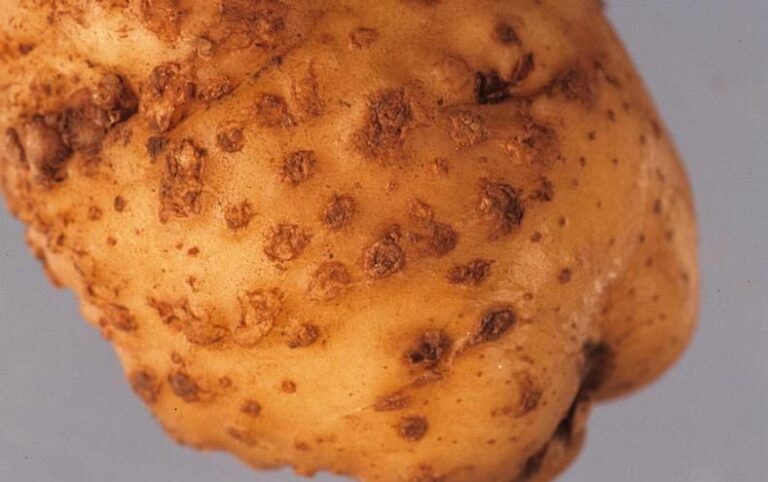
Galls caused by Columbia root-knot nematodes (photo by Gerald Holmes, Cal Poly San Luis Obispo, Bugwood.org.
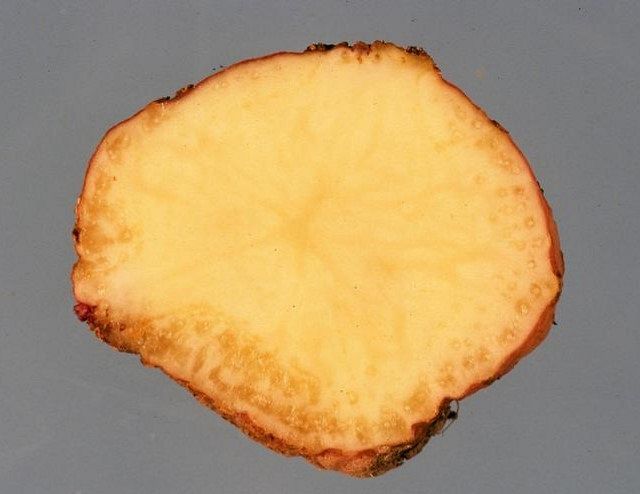
Necrotic spots caused by Columbia root-knot nematodes (photo by Gerald Holmes, Cal Poly San Luis Obispo, Bugwood.org.
Control Options for Root-Knot Nematodes on Potatoes
| Material | Application per Acre | REI (hours) |
PHI (days) |
MOA | Efficacy | Notes |
|---|---|---|---|---|---|---|
|
dichloropropene (Telone II) |
15-25 gal | 5 d | - | 11 | E-G | Columbia root knot nematodes: use 20 gal/A for mineral soil or 25 gal/A for muck. Northern root knot nematodes: use 15 gal/A for mineral soil or 18 gal/A for muck. Shank-in at 18-inch depth or more. Soil temperature must be between 40°F and 80°F. |
More details
| Material | Application per Acre | REI (hours) |
PHI (days) |
MOA | Efficacy | Notes |
|---|---|---|---|---|---|---|
|
dichloropropene (Telone II) |
15-25 gal | 5 d | - | 11 | E-G | Columbia root knot nematodes: use 20 gal/A for mineral soil or 25 gal/A for muck. Northern root knot nematodes: use 15 gal/A for mineral soil or 18 gal/A for muck. Shank-in at 18-inch depth or more. Soil temperature must be between 40°F and 80°F. |
More details
| Material | Application per Acre | REI (hours) |
PHI (days) |
MOA | Efficacy | Notes |
|---|---|---|---|---|---|---|
|
oxamyl (Vydate C-LV) |
2.1-4.25 pt | 48 h | 7 d | 1A | G | Start with an in-furrow application at planting and follow with foliar applications via chemigation. The in-furrow application is optional but is recommended for risk-averse growers and when following alfalfa. |
More details
| Material | Application per Acre | REI (hours) |
PHI (days) |
MOA | Efficacy | Notes |
|---|---|---|---|---|---|---|
|
oxamyl (Vydate C-LV) |
2.1 pt | 48 h | 7 d | 1A | G | Apply the first foliar treatment of 2.1 pints/A via chemigation at crop emergence. Follow with 2.1 pints/A when soil degree-days reach 1440 DD °F, and then 2.1 pints/A on 14-day intervals until 7 days to harvest. |
More details
| Material | Application per Acre | REI (hours) |
PHI (days) |
MOA | Efficacy | Notes |
|---|---|---|---|---|---|---|
|
oxamyl (Vydate C-LV) |
2.1 pt | 48 h | 7 d | 1A | G | The first foliar treatment should have been applied at crop emergence. Follow with 2.1 pints/A when soil degree-days reach 1440 DD °F, and then 2.1 pints/A on 14-day intervals until 7 days to harvest. |
More details
| Material | Application per Acre | REI (hours) |
PHI (days) |
MOA | Efficacy | Notes |
|---|---|---|---|---|---|---|
|
oxamyl (Vydate C-LV) |
2.1 pt | 48 h | 7 d | 1A | G | Foliar treatments, using 2.1 pints/A, should be applied via chemigation on 14-day intervals until 7 days to harvest. But do not exceed 19.2 pints/A total for the season. |